Wednesday, February 20, 2008

Ossie Clark


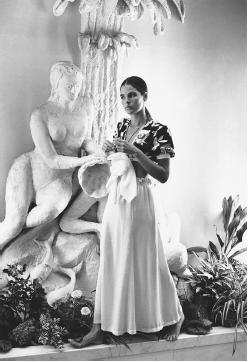
This time’s sort-of-historical blog post is another bisexual I never met – fashion designer Ossie Clark. He’s also my second Elegantly Dressed Wednesday subject, because not only could he look pretty smart himself, he made lots of rich and lucky women look good, and had an influence on the style of plenty of poorer women too – including the teenage me.

Born in 1942 and murdered in 1996, Ossie Clark was a terrific designer who made some of his best clothes in the late 60s and early 70s.

The clothes he made tended to the flowing, like the pictures I’ve posted here.


A kind of 40s meets 70s crepe or chiffon. And very sexy, in my opinion.


I can’t find many pictures that will allow me to post them here, but the site for the London Victoria and Albert Museum’s 2003-04 exhibition has quite a few to look at.

A fashion historian said to me that she thought he really liked women, because his clothes made female bodies look good. They didn’t require you to have a particular body shape – certainly not the rake-thin type usually associated with fashion.
Of course, nowadays his clothes are characterised as “vintage” so you can buy them in auction houses and upmarket clothing emporia. Unsurprisingly, they are really expensive – this one (below) was sold in 2004 for £3592.


Still, it’s the sort of thing I’d love to wear if I had the money/ thought that spending that sort of money on clothes was morally defensible!

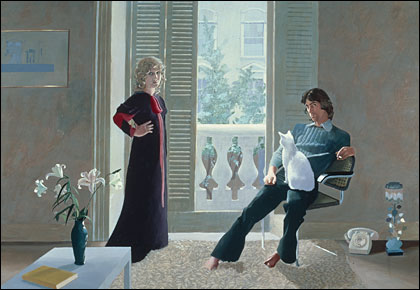
Many of the clothes he designed were done in collaboration with his fabric designer wife, Celia Birtwell, who nowadays has a rather pretty collection for Top Shop. There are some more of their 70s clothes on that site too.

This really famous picture of them was painted by David Hockney and now hangs in Tate Britain, in London.


So what about his bi-ness? He’s written about on this blog, entitled Gay for Today, but I think the writer is a wee bit snide by saying:

In 1969 he married Celia Birtwell. Although Ossie was openly bisexual and carried on many affairs with men, he and Birtwell had two sons together.


And your point is, Mr Gay for Today?

What can I easily find out about him? Well, he lived the Swinging Sixties life, with the sex, drugs and rock and roll that that implied – particularly the drug part, which apparently set his marriage and career, and subsequently his whole life, on the skids.

In 1996 he was murdered by his (male) ex-lover, very violently indeed. A sad and sorry end really to such a creative life.

For more on him, go here, and his posthumously published diaries are available here. I feel there’s a lot more I could write, but - boo-hoo – no time for the research.

He’s also been in the news recently, as his sons tried to stop his name being used as a new Ossie Clark brand, which they considered exploitation.

Speaking of fashion designers, I have a feeling that Calvin Klein was bi too. Can anyone advise?

Wednesday, February 13, 2008

Bisexual history


So what is bisexual history then and why – apart from the fact that it is LGBT history month (see my last post) – am I blogging about it?

Well, the quick answer to that is that bi people are essentially “hidden from history” as Sheila Rowbotham wrote in the 1970s about women in the past. And I would dearly love to see it, them and us out in the open.

I am doing my microbit. As well as writing about how men who had sex with men before WW2 often seemed to act, or feel about their experiences, somewhat differently than they do now, and how some young women in the 1920s seemed to be having relationships with each other, I wrote a few blog posts about a year ago about bisexuality in the 70s, 80s and 90s – what I remember, in a nutshell. Bizarrely that is now history too. You can see them all in the history link to the right of the page.

But what about before that?

The gay liberation movements of the 1970s set about finding, recording and reclaiming the lives of gay people across the ages – we are talking pretty much exclusively north America and Europe here. They found people across all time – mainly men, mainly rich, but not all - who had same sex relationships.

It used to be, and probably still is, argued that it is simply inappropriate to label people gay, lesbian or bisexual when those terms were not used at the time, and people would not have considered themselves in that way. Sexuality before the end of the 19th century was perceived in terms of the act, not the identity, and whether or not you married was what was important. So partly as a result of that – and also for political reasons – pretty much anyone gay historians could find who had other than other-sex relationships was treated as gay for reclamation purposes.

It’s certainly true that many or most people earlier than say the 1970s (and even now almost everywhere in the world) who would like to have same-sex relationships were compelled to at least appear to be having straight ones.

Nevertheless, it is also true that many people have been claimed as gay/lesbian (three being Virginia Woolf, Oscar Wilde and indeed Sappho – pictured above, although how can anyone really be sure it is her?) who seemed to have authentic romantic or sexual attachments with men and women. So while it might have been a good idea to claim them as lesbian or gay in the 1970s, now I think it’s time to take a more nuanced view of their sexual complexities.


Other than that there are, of course, reports of men who put it about with all and sundry… the 17th century poet and satirist the Earl of Rochester, for instance, pictured left. A fictionalised version of his life featured in the film The Libertine. Very little of his sex with men was apparently included.

As usual in matters historical, written records are overwhelmingly about men, specifically rich and/or aristocratic men, so we know much more about what they said, did and wrote. But that doesn’t mean there is nothing at all written about women, just that it is harder to tease out. Anne Lister, for instance, a wealthy 19th century Yorkshirewoman, lived as a lesbian and had many affairs with women before marrying the wealthy heiress Ann Walker. But what about her other girlfriends? Mightn’t some of them have loved men as well as her?

One shining example of bisexual history is Eva Cantarella’s book, Bisexuality in the Ancient World - an academic look at ancient Greece and Rome, the (mainly) male bisexuality that went on there, and the constraints – of which there were many – that applied. I do have this book but as it is currently in storage, I can’t enlighten you any further.

So have there been any other history books from a specifically bi perspective? I can’t find any, but if anyone knows of one I’d be mighty glad to read it.

In the meantime, there are some bi-themed history features here.

Tuesday, February 05, 2008

B-free LGBT history month


Another month, another theme, and February in the British Isles is LGBT History month. Or, to be more accurate, gay history with a few lesbian events, some trans stuff if you’re lucky, and nothing bisexual whatsoever… month.

Still, as the only bisexual blogger with a strong interest in and a reasonable knowledge of history (probably) I can add my two groats’ worth.
So, to start us off, a bisexual novel of the 1920s: Dusty Answer.

Judith is a lonely child (and later woman) whose (rich, by normal standards of our time and hers) parents don’t take much notice of her. She does, however, live next to a house where a group of cousins come to spend summers. In the years leading up to the first world war, she falls in love with this family - Charlie, Mariella, Julian, Roddy and Martin - finding them entrancing. Charlie and Mariella marry very young during the war, but Charlie is killed, leaving Mariella - a widow at the age of 19 - to bring up their son alone.

Judith – and Roddy and Martin – goes to Oxford, where she falls in love with Jennifer. Their relationship is described in very romantic and sensual terms:
“She roused herself at last as Judith bent to kiss her good night.
‘Good night my-darling-darling,’ she said.
They stared at each other with tragic faces. It was too much, this happiness, this beauty.”
And much in similar vein. Jennifer runs off with another woman, however.

Roddy, who Judith falls in love with later, has a constant companion in the shape of Tony. Tony is an artist who spends much time in Paris…

It all ends sadly, this melancholy tale, but not because they have chosen the wrong gender love objects. Everyone is fated to be unhappy in love, and in life for that matter. Absolutely everyone in this novel is miserable.

But while no one actually has sex with anyone – this was published in 1927 after all – I would certainly argue that this is a bisexual novel. The characters seem to moon after individuals and no character cares or indeed seems to notice whether they are men or women. Of course, they all intend to marry. That’s what people did then. But love existed outside that too.

When I was a student in the late 70s, I read and loved this book. It was recommended to me by Kate Millett (not personally, of course, but in her autobiography Flying where she talks about reading it.) Now that I am back at the university I came from, I got the self-same copy out – now rather more tatty than it was 20 whatever years ago – to read again.
Dusty Answer is a rites of passage novel, something that would have appealed to the young woman I was when I first read it. Now I am more struck by how old-fashioned it seems, how snobbish and privileged the characters are. And how sad – the melancholy seeps from every page. All Rosamond Lehmann’s books (that I have read anyway) have this melancholy.

I think it’s almost certain that Rosamond Lehmann knew that parts of her characters’ lives could be construed as homosexual (she was living in bohemian London, where there was rather a lot of it going on at the time!). But, as I have written quite a lot on this blog, the “dichotomous view of sexuality” – you’re either straight or gay – didn’t have a hold over society in quite the way it does now. She wrote some interesting things about the reactions to her writings here.

A fascinating period piece, but a lot harder to "relate to" than I remembered.

Wednesday, January 30, 2008

Nothing natural?


In the Independent newspaper today, they had a long and involved piece entitled Scientists discover way to reverse loss of memory.
Briefly, a man whose brain was operated on to try to suppress his appetite suddenly recovered very vivid memories from 30 years ago. The more research is done on the brain, the more scientists find that manipulating it in some way alters how people act, think, feel and so on.

Another piece from the New York magazine forwarded to me by the New York Area Bisexual Network looked at various sorts of research that has been done by scientists from different fields looking at the so-called causes of homosexuality – length of fingers, chromosomes and so on and so forth. It also suggested that various stereotypical traits of lesbians and gay men might be biologically based, which to me beggars belief – it’s ahistorical and ignores cultural and geographical differences. I remember, for instance, when men having long hair was considered to be a sign of homosexuality. Who would that even occur to now?

“They’re born that way” seems to be the notion du jour – of this and pretty much every other age - and popular opinion likes to go down the common sense track, where if it seems to be true – because of repetition and stereotype, then it must be true. So male hairdressers are gay and female footballers are lesbian. Perhaps bisexuals are footballing hairdressers then?

So is that it then? We are all born gay or straight (or bisexual – although no one seems to be researching that). And we’re all man/woman, male/female, masculine/feminine and that’s that? Isn’t that just a tad simplistic? I think so.

In short, there’s a massive gulf between people who think sexuality is constructed in society - that we end up as we do because of our individual experiences in this particular space and time – and those that think our sexuality is a result what is going on in our brains / with our chromosomes bla de bla.

Science or queer theory?

I am particularly struck by this now as I’ve been reading queer theory for the first time in my life. I’ve always known it existed, but never having been schooled in it I was a bit intimidated, to be honest. But if you start from the beginning, say here it’s not as scary as all that even if it is a bit hard to pin down and define.
Anyway, while thinking that gender is formed in society, that gender is not glued to biological sex (what is that anyway?), and that sexuality is simply a role you play might be all very well to some readers of this blog, it wouldn’t really play in Peoria (do people still say that?)!

Now, I’m well aware that I don’t know enough about science on the one hand, or queer theory on the other, to have a properly informed opinion but that never stopped anyone in this debate. In any case, if you know a lot about one you are not likely to know a lot about the other.

It has always seemed to me, though, that the way people experience and express their sexuality varies so terribly much between cultures, both historically and geographically, that it has to be nonsense to say anyone is born to be gay/bi/whatever.

But hey – I’m a both/and type of bisexual. Do we have to throw out the born that way baby with the biological bathwater? Many people feel that their sexuality is such a deep and profound part of themselves that it is “natural”. They don’t feel that it is a role they can put on and take off. But are they right? What role does biology and neuroscience have to play in sexuality? Answers on a rather large postcard please.

Thursday, January 24, 2008

Getting Bi


Bi? Fancy yourself as a writer? Then you should send your contributions to the wonderful women below. The first edition of Getting Bi was and is absolutely fantastic and fascinating... If you haven't got a copy, buy one instantly here.

Otherwise, read below....

CALL FOR ESSAYS:

Getting Bi: Voices of Bisexuals Around the World, 2nd edition

--Do you have something to say about being bisexual?

--Do you have a story about coming out as bi?

--Do you feel you could identify as bisexual but choose not to?

--Do you find connections (or conflicts) between your bisexuality and
other parts of your identity or life?

--Do you have something to say about desire? About relationships? About
religion? About community? About politics? About the position of
bisexuals in the place or community you call home?

If you answered yes to any of the above questions, we want to publish you!

*We seek short personal essays or poems (200-1000 words) by bisexuals
from Central or South America, Eastern Europe, the Middle East, Asia, or
Africa. We seek Muslim voices from anywhere in the world. *(Essays from
people from other places and backgrounds will also be considered but our
present focus is on broadening representation. )

If you don't want your name in print, you can write under a pseudonym.
If you think you're not a "real" writer and would like to be included in
this anthology, we want you. If you're not comfortable writing, we can
interview you. If you are not comfortable writing in English, write in
your native language and we will translate your essay.

Essays will be published in the second edition of Getting Bi: Voices of
Bisexuals Around the World. The new anthology will be published in 2009,
in dual editions (English and Spanish).

The first (2005) edition includes personal narratives by people from 32
different countries, on 6 continents, ranging in age from 15-79. Please
help us make this amazing collection even broader in scope!

Send submissions to Robyn Ochs (robyn@robynochs. com) by June 30, 2008.

Thank you, and please help us spread the word! !

Robyn Ochs (http://www.robynochs.com) & Sarah E. Rowley, Editors

Monday, January 21, 2008

I'm pleased that I exist but...

A report from the American Psychological Association that (female) bisexuality is a stable identity has been doing the blog-rounds over the past few days, as well it might.

According to planetout.com from which I lifted this (and a whole heap of other sites):
“A study of 79 bisexual, lesbian or unlabeled women ages 18-25 over a decade found that bisexuals maintained a stable pattern of attraction to men and women, according to a press release from the APA. The study also disproves the myth that bisexual women are unable to commit to long-term monogamous relationships. Results were published in the January issue of Developmental Psychology, published by the APA.
University of Utah psychologist Lisa Diamond, who conducted the study, said in the press release that the research provides the first experimental study on the topic and debunks long-standing beliefs.
"The findings demonstrate considerable fluidity in bisexual, unlabeled and lesbian women's attractions, behaviors and identities and contribute to researchers' understanding of the complexity of sexual-minority development over the life span," she said.
Bisexual women were more likely than lesbians to change their identity but tended to switch between bisexual and unlabeled rather than lesbian and heterosexual.
At the end of the 10-year study, most of the women were involved in long-term (more than one year in length), monogamous relationships -- 70 percent of the self-identified lesbians, 89 percent of the bisexuals, 85 percent of the unlabeled women and 67 percent of those who were then calling themselves heterosexual. (The Advocate)”

So great ammunition for anyone who’s been on the receiving end of the: bisexual women are just confused / waiting for a man to come along / you watch out – it’ll all end in tears stereotypes.

What do you think?

There was a bit more background to the study, and lots of really interesting comments on the great blog Feministing. Jessica, who writes it, asks her readers whether the study concentrated on women because men’s bisexuality is less acceptable and seen more as a temporary stop on the way to gayness. (Well, just because that’s true, doesn’t make it a reason not to study women’s behaviour/ identity/ whatever.)

I do have this nagging feeling, though, that all this new-found quasi acceptability bi women seem to be enjoying (I say seem, because I’ve seen little evidence of it in “real life”) actually is because men (some: not all by any means, despite the stereotype) like it. Fundamentally, I believe that women's bisexuality is actually a bit more challenging than that - or it can and should be. I want women’s relationships with each other, sexual and otherwise, to be taken seriously and not always viewed in relation to men. I want bi women who bear no resemblance to Tila Tequila to appear in the media. I want bi women of all ages, shapes and sizes – not just young and pretty ones – to be able to live without harassment. And really, I know that this won’t happen until bi men are taken a bit more seriously too.

Tuesday, January 15, 2008

The first of the year

Promptly (I promised mid-Jan in my last post and I am as good as my word this time), here I am, unrelated deadlines met, back on my blog.

I didn’t want to be thinking about blogging while I had other things to concentrate on, but that doesn’t mean I wasn’t keeping an eye on The World of Bisexuality.
One of the ways I’ve been doing this is through setting up a Google Alert for bisexual stuff. It’s a great idea, actually – it means that whenever a website of any sort anywhere puts the words bisexual, bisexuality or bi online, I get to hear about it. Just search for Google Alerts and it'll tell you how to do it.

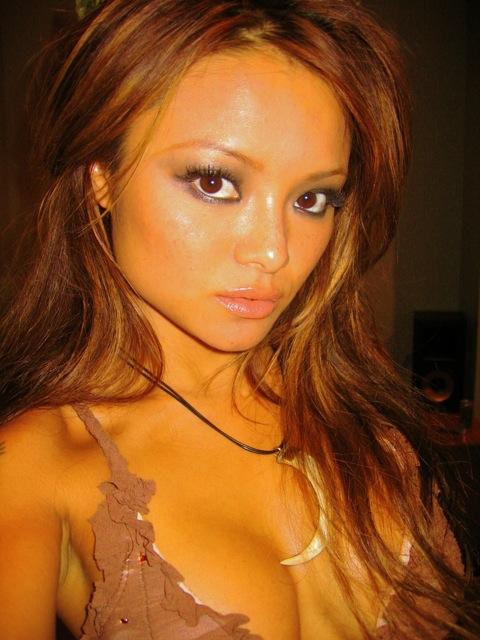
Because of this, I know that Tila Tequila has dumped Bobby (her hot boy date from the last Tila Tequila series), the better to have another bisexual dating show; that it would have been Simone de Beauvoir’s 100th birthday – and scandals about her sex life are potentially clouding new autobiographies; I know that, in several blogs, women are discussing what people think about bisexuality and how they can find a community to call home; I know that bi people had a “coffee klatch” – whatever that is - in San Francisco last night; and I know that there’s a lot of people floating around in the ether who don’t like bisexuality. Don’t think I’ll link to them.

Like lots of bloggers, I have comment moderation on here. That’s not simply due to spam commenters: who knew that there were important connections between feminine lesbians, UFOs and ancient Egyptian gods? Not me, although 2,000 word comments on tried to tell me otherwise. Then there’s the biphobia. Now I don’t think I’m a “sick fuck”, but others obviously disagree.

I tell you what, there’s an awful lot of weird and freaky biphobia out there. Reason to keep writing what I consider to be no more than common sense, I suppose.

Monday, December 31, 2007

Happy new year

It's a fortnight (plus two days) since I posted my last blog. Yes, despite my last new year's resolution to post more often on this blog, time and life took over and I just haven't. Ah well...
Anyone who read my posts earlier in the year knows that it's been a tough one for me, and I'll be glad to see the back of 2007. 2008 should be much, much better. I hope you have a good one too.

The next episode of my thoughts and theories on all things bisexual will arrive around the middle of January. Hope to see you then.

Friday, December 14, 2007

Queer London


No, not a description of life as we know it now but an absolutely fantastic book that I have been reading. Queer London, by Matt Houlbrook, is about gay life from 1918 – when the first world war ended – to 1957, and the publication of the Wolfenden Report, which recommended that sex between men in England and Wales should no longer be a crime. Life in London, obviously, and between men – slightly less obviously. Things were rather different for women, so that’s another book – in fact, one that I am reading now – and blog post.
It was a very mixed picture for gay men in London at that time. For instance, in the 20s and 30s, there was quite an active gay pub, club and café scene, with lots of cottages (at that time, old-fashioned metal pissoirs that were in the middle of the street) where men could pick each other up. For most of that time, too, there were four or more Turkish baths where you could be steamy in several senses.

But of course, having sex with another man was illegal and from time to time there were clamp-downs. Clubs would get raided and cottaging individuals would be targeted by agent-provocateur style “pretty policemen”. (Pretty policemen were still operating until at least the 1980s, as I remember.) Men who were caught faced prison and subsequent ruin.
Homophobia was rampant – as Quentin Crisp, above (probably in the 1930s) testified. But not everyone experienced homophobia in the same way, and many gay men were in great demand as entertainers. Fine if you were amusing, I suppose, not so great if your bent was in the sphere of road digging or accountancy.

Bi men
One of the most fascinating things for me about this book was to look at how sexual identity, and the categorical division between straight and gay men, has developed. Boy, oh boy, were things different then – probably until the 1950s, when being “masculine” started to preclude having sex with men.
So while there were men who were only interested in having romance or sex with men, there were many other men who were quite happy to do so some of the time.

For instance, there were young men (especially but not only working class) coming to London and mixing in same-sex environments where women were not available. They often had homosex and sometimes romantic relationships with each other too. Then, when they decided it was time to marry, they got a girlfriend, married her, and generally speaking said to themselves: on to the next part of my life now. Sometimes/often, they remained close friends with their male ex-partners who were doing the same.

Sometimes there was a financial involvement in this. For instance, people like gay writer Christopher Isherwood (in his case in Berlin in the late 1920s-early 1930s) had boyfriends who were romantically and sexually involved with them, and kept by them, Then, in their mid or late 20s the boyfriends got married. In neither of these cases did they seem to be “turning their backs” on their “gay pasts” and saying it was a mistake and they were really straight after all. It was much more of a moving between gay and straight behaviours.

There were other young men who were primarily into girls but unabashed about the fact that they would have sex with another boy if girls were not available. As one said: “I had sex with a brown-hatter last night for a laugh”. There was no sense of losing face or masculinity by doing so. Straight men, on the other hand, were often seen by men who were committedly gay as “trade” or TBH (to be had). Or indeed Naff (not available for fucking).

Then there were soldiers - the Guardsmen (why Guards specifically, as it seems to have been?) who would have sex and fun with older wealthier men – who usually gave them presents, meals and drinks etc. This was semi-prostitution but there seems to be no real sense that the Guardsmen were doing it solely for money – they were “made a fuss of” and got, rather than spent, money. Working class masculinity was part of their attraction for their admirers.


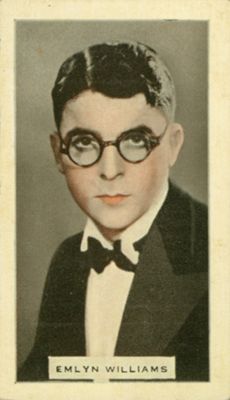
Middle class men seem to have found it a bit more difficult. According to his autobiography (Emlyn: An Early Autography, 1927-1935, long out of print) playwright and actor Emlyn Williams found it difficult to reconcile his feelings for men and women. According to Matt Houlbrook, middle class men were more likely to feel guilty about breaking their marriage vow. Being masculine, for middle class men, was more to intimacy and fidelity, rather than physical strength. EW came to London and had deep relationships with men but remained attracted to women. When his male lover died, he got a girlfriend but was still attracted to men. When another man let him down, he married his girlfriend.

Anyway, I loved this book and Matt Houlbrook – an academic at Liverpool university – has also written an interesting paper for anyone who wants to look at the role make-up played in gay men’s lives in the 1920s-30s.

Between the Acts

Some of this is fleshed out a bit more in the book Between the Acts. It’s the life stories of 12 gay men from the earliest years of the 20th century, who were interviewed during the late 1970s when many of them had become involved in the Campaign for Homosexual Equality. Several of them mention getting married themselves between the wars – with various degrees of success – but one, Sam (with the chapter heading The Dancer’s Life) also talks about being the boyfriend of (several) married men,
In one instance, Sam’s boyfriend’s wife is tolerant of, even happy about, their relationship. When she is about to give birth to her third child, Sam actually moves in to look after the family.
I love that anecdote. In history, in life stories, we get to know some of the complex real lives behind the simplistic stereotypes.

Wednesday, December 05, 2007

Bisexuals lost in France

I’m doing a spot of travel writing at the moment (yes I told you I didn’t just write on bisexuality) and I’m in Avignon, France.

Gay behaviour, or people who look as though the might be gay, are not terribly thick on the ground in France as a whole – so I was rather surprised to find myself in what seemed to be a gay restaurant. Le Brigadier du theatre serves traditional provencal food, and is decorated in high camp style with gold and silver cherubs, red walls, and chandeliery dripping from all vertical and horizontal surfaces. And men (well, one other woman who seemed to be with a gay couple). Tables full of men.

I don’t pretend to understand French culture. Not really. They have a big thing about the naturalness and inevitability of male/female relationships – or rather L’Homme et La Femme. Masculinity and femininity (for men and women respectively!) rule. Then there’s the influence of the Catholic church, the family… In southern or Catholic-influenced Europe, as distinct from Anglo-Saxon Europe, sexuality is considered to be a private matter and not something to shout about. As a result, the gay scene and identity has never taken off in quite the same way.

Can we see you?
The Parisian group Bi Cause (because love is a right) seems to be up and running, though. They meet every week and there’s a lot on their website if you can read French (and I think you can translate sites through some kind of online magic too, no?) Apparently, there’s an article by Catherine Deschamps (who wrote the book Bisexualite Le Dernier Tabou – not translated into English as far as I know) in the newest Journal of Bisexuality - which I can't find an online link for! - talks about Bi Invisibility, something that was discussed a great deal in the English-speaking bi world 10 or 20 years ago. We now have rather a lot of spurious bi visibility – as I said before – so this kind of discussion has died away. Perhaps French pop stars don’t paw each other a la Madonna and Britney.

When in France
I have plenty of previous in France. As I wrote before, I spent part of my yearning youth in Paris. I expected to encounter bisexuality there (why?) but certainly didn’t. Instead, I found men, men and more men – pests that they were. I didn’t know till later that I was living on the edge of an upmarket red-light area.

But in the 1980s, when I worked at an organisation called the Women’s Film, TV and Video network, my colleagues and I went to the women’s film festival that was and is held annually in the Parisian suburb of Creteil. Many of the women at the festival embraced a kind of high femininity which we from the UK found both regressive and baffling. One of the festival programmes showed a woman directing a film while also wearing a ballet tutu. I mean to say?!

When we were there we (my non-sexual friends and I) went to the Turkish baths at the Mosque – and what an eye-opener that was. I’m not saying that there was any actual sex going on there between the women – oh no no no – but what there was was the highest level of sexual tension, rubbing of body lotion into one’s friends bodies, and basic staring that I have ever seen anywhere. Maybe it’s not like that now – the last time I went, I was on my own and it was entirely different – but in the 80s, it was awesome. Literally.

We also went to a then-famous lesbian club Le Monocle (14 blvd Edgar Quinet, in the 14th arrondissement). It was odd. Although there were women there who were obvious couples, there were also men who’d clearly gone there to gawp. Remember, this was at the time when, in the English-speaking world, lesbian-feminism ruled. I just googled the club, and it still exists – the new Monocle – as a swingers club.

That tells you a lot you need to know really. There is a massive swingers scene in Paris (just look at the loisirs section in Pariscop magazine). Man and Woman united –naturellement – but with the saucy naughtiness that stereotypical Frenchness implies.

Thursday, November 22, 2007

Underground at the House of Homosexual Culture


This coming Saturday, I’m going to be spending the day at the above, running the tea stall. There’ll be beverages, and fairy cakes – of course – and Santa’s little helpers of every gender. The wonderful writer Sarah Waters will be opening it. So if you’re in London, come on down.
I won’t be the only bi curiosity on show: those socially-minded folks The Bisexual Underground will have a stall. They meet monthly in a London pub for darts, board games, chatting and so forth.
And I think the Bi Underground is about it for the organised London bi scene at the moment – I can’t even tell if the London Bi women’s group is still going, or the London main group that was active for 20 years. Of course, there are places like fetish superclub Torture Garden – a “not safe for work site” - of course, where there is no shortage of behavioural bisexuality on display. Male/male couples, female/female couples, female/male couples, groups of friends or lovers, people who are clearly transsexual or whose gender is hard to determine… Everyone can be gorgeous if they have made an effort; everyone has a chance of being desired by someone there.

Is there a bi culture?
I’ve been asking myself this question quite often lately and I think the answer is probably, sadly, no. The reason for the question is that I’m hanging out a lot with, and seeing lots of events advertising: lesbian and gay culture, lesbian and gay communities, bla bla bla. This event is, after all, organised by the House of Homosexual Culture. They are great blokes and I love them. Bisexuals have a place on the gay scene, and always have had, even if we haven’t been recognised. But is that enough? Could there ever be a house of bisexual culture?
It's hard to imagine. Bi people are too diverse. That’s why I have a link called 57 Varieties. Some bi people veer towards gay culture, others straight. There’s no one thing we all want.
There’s a queer culture – encompassing all sorts of people who happen to be not mainstream heterosexual, but which leaves out many “straight-acting” bis. And there are subcultures with lots of bisexual people – swingers to anarchists and hippies (well, I think the anarchist bit is true, anyway).
But can you call the few bi groups, conferences, newsletters and so on a culture? Not really. I’ve tried to define (for myself) what “a bisexual culture” might encompass but I can’t. Clothes, creativity, music, secret signals to indicate to someone that you might be bi? No. There isn't any of that.
There is, though, a history of bisexuality – in particular how it was seen by the general public - ranging from bohemians and the Bloomsbury Group in the 1920s and 30s, David Bowie in the 70s, the influence of feminism and the sexual liberation movements around the same time, plus the organised bi community. That’s something you can trace, and I’ve stressed that quite a bit in this blog. It’s something to hold on to.

Monday, November 19, 2007

Bisexuals a bit less jolly... revisited


I’ve been doing a lot of reading recently about unforeseen consequences – the “unknown unknowns”, if you like. You have no idea that something could happen because A had never crossed your mind as having anything to do with B. It certainly resonates with what’s happened to my blog viewing figures.

Ever since I posted up a picture of Angelina Jolie on this blog a little more than a month ago, my reader figures have gone through the roof. Well, as far as “the roof” for a non-publicised, non-monetised, non-famous blog like this is concerned. Today, more than 1,000 people will read this blog. Well, I say read, but in actual fact it’s more like: click on for a nanosecond, see what’s here, then click off immediately. This blog is currently listed as number two on Google Images’ places to see Angelina Jolie. And then last week, aol.com put a link to this blog right in the middle of a story. Mini jackpot.

So, if all I wanted was “clicks”, then all I’d have to do is post endless pictures of Angelina Jolie – with perhaps the occasional picture of a buff-looking man to attract a few people who were into them.

What's it all for?
But that’s not all I want. I want people to actually read this blog, to think about what it says. Some of them have, I suppose. Some people who would never access sites that are purely and simply about bisexuality. When someone does stay on this site for half an hour, and they have found it through her picture, then I feel really encouraged.

And that, I suppose, is why I think I was wrong with some of the things I said about Angelina Jolie. I stand by the idea that, if we “ordinary people” rely on slebs to be our role models and to show us how to live our lives, then we are sunk. The issues we face are simply too different, and we will never be able to change things if we rely on help from “above”. But. It seems that Angelina can reach parts that I certainly can’t – and nor can the bi community, or health educators, or politicians, or books, or less glamorous spokespeople. Obvious really.

She is a larger than life person, yes, someone with a special life, which is one of the things I have a problem with. But as that is what many people really want her for, and, although this may sound harsh, to live through her, then she certainly is valuable as a spokeswoman, a beacon for, bisexuality – or indeed anything else.

Because she – or her image – is certainly doing something I can’t.

The next post will have absolutely nothing to do with celebrity. Promise.

Monday, November 05, 2007

Tila Tequila and the MySpace bisexual


You couldn’t make it up – although someone obviously has. A bisexual dating show where a woman who is quite literally famous for being famous is getting “16 gorgeous straight guys!" and "16 hot lesbians!" to compete for her affections on the MTV show A Shot at Love with Tila Tequila. It sounds positively demure besides her previous series: Pants-Off Dance-Off. And that’s “pants off” in the underwear sense of the word, rather than simply an overly constricting pair of trousers.
Now Tila Tequila is most famous for having completely invented herself as a sleb through self-promotion, and clearly she’s very good at it, with currently 2,170,161 MySpace friends – more than when I looked a couple of hours ago. Now she’s a singer/actress/presenter/model/stripper/all-purpose brand, and good luck to her I suppose.
She has also been credited for giving rise to the term MySpace Bisexual, which Urban Dictionary defines as:
“A girl who makes out with other slutty chicks at parties and then claims to be bisexual because it's trendy to say so and gets people's attention on Myspace.
Pretty much any girl on Myspace who lists her sexual orientation as "bisexual". Hence, Myspace Bisexual.

Well, being a “girl” who lists my sexual orientation as “bisexual” on MySpace I obviously have a quarrel with that. Actually lots of quarrels with that. You could equally well call them “Girls Gone Wild”. But moving on…

Now this show has attracted a lot of commentators – both bi (who hated it), anti-celeb (who hated it) and homophobes (who hated it). But also, unfortunately, people who didn’t necessarily hate it but considered that it gave a marginalised group (bisexuals) some much-needed publicity.

Yet, given that millions of people are watching this programme, what can we make of it? In fact, it reminds me in some ways of the Jerry Springer programmes of the 1990s, where bisexuals took their place among all the other freaks who wanted to show off in public.

It seems to me that the problems with A Shot at Love with Tila Tequila are a) that she had to lie to the contestants, making out that she was straight/lesbian – and Any Fule Kno that bisexuals lie; and b) that because there is nothing else about bisexuality on TV, this is seen as What Bisexuals Are Like.

The world at large has a strange and unusual view of “bisexual relationships”. Even Ms Tequila herself says: “The show will be about me finding love as a BISEXUAL!!!!! THAT IS CRAZY, RIGHT?”. Er no… how sad it would be if that were true. But it isn’t and I can’t believe she thinks so either. The world is actually full of bisexuals having good, bad and indifferent relationships, if people only knew. And they certainly aren’t going to be finding out through this show.

Of course, there are stereotypes a gogo in this programme, but that’s reality TV. Anyone who seriously thinks that, say, The Bachelor, is a realistic view of heterosexual relationships needs to be thrown into a vat of Mills & Boon novels and left to claw their way out.

The problem isn’t that there are wacky views about bisexuality in the media – there are wacky views about everything - it’s that all of them are wacky. Isn’t it about time that there were some genuine ones too?

An hour later…
Tila Tequila has added another 46 friends.

Wednesday, October 31, 2007

Black History Month


Right on the very last day, here’s my teensy contribution to Britain’s Black history month. (Do people have it elsewhere? No idea.) Anyway, here are two Black bisexual people that you probably haven’t heard of unless, like me, you particularly like the music of the 1920s and 30s.

So, in chronological order, here’s… Ma Rainey.

Ma – so called as her husband was Pa, and they had a double act, but whose real name was Gertrude - was born in 1886 and was one of the earliest Blues singers. Rainey, in fact, claimed that she had invented the term “Blues” – but that seems unlikely. Anyway, she appeared on stage from the age of 14, and sang the Blues right through the 20s, when she recorded 50 songs in five years.

Among my albums of the 70s, currently in storage, is one called Wild Women Don’t Get the Blues. (If only that were true. But anyway….) And one of the tracks on that amazing collection of feministy, ass-kicking (not a term I normally use, but spot-on here) music is by Ma Rainey. The most famous section goes:

Went out last night with a crowd of my friends,
They must have been women, 'cause I don't like no men.
Wear my clothes just like a fan, Talk to gals just like any old man
'Cause they say I do it, ain't nobody caught me, Sure got to prove it on me.
Ma Rainey, Prove It On Me


Certainly into the girls then – though what she thought of old “Pa” is not known. By me, anyway.

She retired in 1933 – six years before her premature death in 1939 – having done pretty well for herself.

You can buy an album of hers here and if you search around, there are plenty of others too.


Hutch


A few of the blogs I read have signed up to Elegantly Dressed Wednesday – where bloggers post pictures of gorgeously attired individuals (not usually themselves). I certainly think Hutch qualifies.

Leslie “Hutch” Hutchinson, born in Grenada in 1900, spent much of his working life as a cabaret singer in the UK. After a short stay in Harlem, and a brief period in Paris, where he was Cole Porter’s lover, he came to London in 1926. Allegedly the lover of a whole loaf’s worth of the upper crust – from Edwina Mountbatten to Noel Coward – he was enormously popular with “Society” as well as “ordinary people”, singing on the radio a great deal. His voice was soft, sweet and gentle, and he tended to sing romantic ballads…. But he was “tormented” and spent his last years in poverty. What a waste.

There’s not a great deal about him on the internet - wikipedia has a “stub” – but there’s an interesting-sounding biography of him, on sale here.

His music is a bit harder to track down – he has the odd track in plenty of period dance band compilations – but here’s an album which they are practically giving away….

To find out more
Information about bi people is often hard to track down; good stuff – as distinct from racist nonsense - about Black bisexual women or men is even harder. But if you are interested in finding out more about Black British LGBT stuff, rukus promotes events and is organising an archive.
The main Black History Month site is here.

Wednesday, October 24, 2007

Boys keep swinging


A long, long time ago (when the world was new, and the internet not even a gleam in Tim Berners-Lee’s eye) I had an experimenting- bi-curious- questioning boyfriend. He hadn’t done anything with any men at that point, but oh his books… Perhaps they could best be defined as literary gay S/M – Jean Genet, Mishima, and other writers I can’t remember. They had been read, and re-read, and read again. I read them myself, and my mind boggled. Still, I was but a young thing. Innocent, in that eager for life kind of way.
Anyway, he spent a lot of time flirting with my gay male friends. A lot. And we used to go to gay clubs with them, which was quite unusual in those days. There was one guy in particular where you could hardly breathe for the sexual tension in the air between them. After a few months, they snogged at a party – quite publically so that everyone gawped. Soon after they slept together – but after that they hardly spoke, let alone did it again. But why? Had all their sexual tension simply vanished? Or did they just feel awkward? We never really discussed it, so I just don’t know.
Times being as they were, our relationship was very ‘open’ – no one called themselves polyamorous in those days – and he spent a year or so pursuing various people.
Then, suddenly, it all stopped. As far as I know he got married, went to live in the country, and never touched a man again. He seemed to confine his same-sex feelings to the past. It wasn’t as if he was a monogamous bisexual. No, he had “turned straight”. He “didn’t know what I was talking about” when I asked him if he was still into men.
I often think about him and wonder… so was his curiosity satiated? Can you have a “been there, done that” feeling about sexuality? Perhaps you can.

An update
I’ve been wondering a lot about what I posted above, and whether I was right to do it. Was I being ethical? Had I taken someone’s life and just used it for my own purposes? Of course, there is nothing in it that would specifically identify him. The people who were at that party might remember the event as it caused a bit of a stir – after all, he was going out with a girl (me) – but other than that perhaps not even he would recognise this pen-portrait. And while everything I wrote above is true, there are lies by omission: when this was, for instance.
Lifestyle journalists are always slotting their “friends” into their stories: my friend Frances, and her difficult kids; my other friend Maureen and her career failures – but I never believe in them. They are probably the easiest but least rewarding sort of friends: fictional.
But the man above is real. Do I have the right to talk about him behind his back, as it were? Am I exploiting him? Or am I just over-reacting by thinking this is something to worry about?
I have written about him because I think his story raises interesting questions. But I wouldn’t want to hurt him in any way, Above all, he was (and probably still is) a lovely man, and I wish him well.

Friday, October 19, 2007

I’m bi and I fancy a straight girl

One of the women who found my blog recently has found herself in just such a pickle.

So should she do something about it?

No - don’t, please don’t. Although it’s fashionable to think that “all women are bi” I really don’t believe it. In any case, when they (whoever they are) say “all women are bi” they actually mean “will have some kind of same-sex under some circumstances, probably when they are paralytically drunk”. Like Jen Sincero, from A Straight Girl’s Guide to Sleeping with Chicks, who thinks that all women have sleeping with women on their “to do list”.

But if you are sexually and emotionally bisexual, not just “curious”, what you don’t want is to have your feelings trashed by someone who is not sure whether to freak out or not.

I believe that people should experiment (if they want, and as long as they take the feelings of pre-existing significant others into account) but they should always, only, experiment with someone of a similar sort of sexuality to them. So people who are basically straight, or bi-curious, should go for other basically straight or bi-curious or experimenting people. If you are positive that you are really bisexual, then go for someone who’s serious about it too.

The six pint rule
There’s this cute little axiom – all wo/men are gay after six pints, which for a woman would be practically unconscious anyway, surely – and I have met women who have said that they have had plenty of fun seducing “straight” women. Well, that depends what you mean by “straight” (see definitions of bi, above). But, if you are really attracted to someone, do you want them to freak out the next day, acting all disgusted, or start laughing at what you have done together? Mortifying.

Or – worst of all, you are a bit more sober, when you “confess” your feelings and have them say: “I can’t really deal with this right now” and run away, never to come near you again. Or treat you like an object lesson in assertiveness training (very popular in the 80s. but do they exist now?) As in: “I need to make myself clear. I am not interested in you in that way. I really need to be sure you’ve understood that.” Not good. And these are just two of the ways I have been let down ungently. Of course, this can happen whatever your sexuality but there’s nothing like going for someone who really doesn’t fancy women to make you feel crushingly in the wrong.

You might be able to persuade a straight woman to sleep with you, but you can’t make her want to do it again, or fall in love with you. If that’s all you want, then fine. But I think my respondent is more than a bit interested in her “straight girl” and isn’t just up for making a conquest.

So my personal rule of thumb is as follows. Never, ever make a move on someone who hasn’t either got a proven interest in someone the same sex as you, or has loudly and publically declared that they are seriously interested in having that experience. If you are serious about being bisexual, don’t go anywhere near someone who isn’t.

Thursday, October 11, 2007

Bisexuals a bit less jolly today


I don’t think it’s just my age that makes me feel decidedly underwhelmed that Angelina Jolie is perhaps, maybe, just possibly, not actively bisexual any more.
According to Nicole Kristal, on the website After Ellen, the undoubtedly pulchritudinous Ms Jolie has consigned her bisexuality to the past. And Ms Kristal is bereft.
I’m not. I’m sure I’ve written before about my ambivalent feelings towards bisexual (female) celebrities, or rather, as Kristal’s piece rightly has it The Pop-Tart Publicity Whore Bisexual. You can’t trust celebrities, “bi” or otherwise. And I’m not sure they are doing real bisexual people any favours.
Celebrities aren’t real. They have publicists who decide which bits of the person we can see, where they can go, what they can do, the public words that come out of their mouths. Including the B one. And whether or not they should be pawing other celebrities.
Of course, when you’re young, and alone, you need role models. You need people who are successfully doing what you’d like to. Obviously, in a way, celebrities are the best people to do this – after all, they are in the public eye. You can see what they’re doing. But we can’t rely on them to act consistently, or do something if their PR people tell them it might involve the loss of money/status/fill in gap here.
Angelina Jolie is a celebrity, the daughter of celebrities, the wife of another. That is her job, not being an actress, mother, goodwill ambassador for the UN or anything like that. She doesn’t operate under the same rules as the rest of the world. She lives in celebrityland, an other-worldly place built on money, whose inhabitants can do whatever they like as long as they realise that they cannot be themselves. (This, of course, exacts its price – Britney Spears, another possible bi gal, is currently paying it.)
So who knows what Jolie’s real motives are in anything at all? At the moment, she seems to exist to be a larger than life character whose current role is as the 21st century’s answer to Mia Farrow: earth mother extraordinaire. There’s not much space for bisexuality – or any sexuality – in that.

And another one

I feel a bit the same (yawnsome) about Ani DiFranco – who was interviewed in the Guardian yesterday without “bisexual” being mentioned once. Strange, when according to Jennifer Baumgardner, whose book I mentioned in a post not so long ago, Ani DiFranco was almost single-handedly responsible for the increase in young American women’s bisexuality in the mid 90s. But that can’t be true, surely? Were there no other social factors involved? Even David Bowie – who really did encourage a whole lot of young men to “try it out” – was part of a glamrock movement and a culture that was challenging how men and women dressed and behaved.
Angelina Jolie may or may not still be bisexual. The same goes for any other bi celebrity – past or present. But if we rely on them – rather than less celestial beings - to show us the way, then we really are sunk.

Wednesday, October 03, 2007

Shock news: men and women not from different planets

For the past three days, the Guardian has been running some very interesting excerpts here here and here from the new book by Oxford language professor Deborah Cameron.

In this book, The Myth of Mars and Venus, she is looking at how women and men do and don't communicate, and has discovered that really we are not so very different. But "men and women pretty much the same really" doesn't, as she rightly points out, sell books and get their authors on lucrative book tours and chat shows. She particularly has it in for the grand-daddy of the genre: Men are from Mars and Women are from Venus, by John Gray, which I won't link to because far too many people have copies already.

There are plenty more though: for instance, the fragrant Allan and Barbara Pease "internationally renowned experts in human relations and body language" have a whole slew of books with nonsense titles like Why Men Don't Listen and Women Can't Read Maps. Mr Pease gained this expertise as the youngest person in Australia to sell $1m of life assurance and Mrs Pease by modelling and selling advertising. Real experts, then.

How I hate these books. With their glib little catch-phrases, their wacky cartoons, and their ability to over-simplify the most complex arguments, they are an insult to the intelligence, and it always surprises me that people who seem to have triple-figure IQs believe them. “Men want power, achievement and sex. Women want relationships, stability and love,” they say. What all of them? Always?

Not, sadly, that all of those people talking about men and women being "hard-wired" are dimwits. In the first excerpt from her book, she discusses some who aren't. But they are still mistaken - perhaps in a similar way to Simon LeVay who, when looking for the "gay brain", was mistaken not least because he knowingly and deliberately ignored the fact that some men are bisexual. His initial hypothesis - men are gay or straight - was wrong.

Cameron has a political explanation as to why so many people are keen on these differences being "natural". As she says, people have never been less at the mercy of biology, or men and women less different from each other. However, much of this simplistic writing implies that - because differences are "natural" - we'd all be happier and less frustrated if we reverted to the way things used to be.
But things in the western world have changed so much in the past 100 years: even in the past 20, which they couldn't have done if the previous way of being was wholly natural. Men and women relate differently from when I was a young woman; expectations of how we should live our lives are radically different. Anyone with any sense of history or geography knows that gender expectations vary from from place and time. But those changes that do still exist seem more stubborn.

I think people like these pat explanations because they are easy. Because they don't have to struggle with their partners, because they don't have to make any changes; they don't have to think or challenge anything. Society, in the abstract, doesn't have to transform itself to take these changes into account. We can all go round complaining and tutting about the "opposite sex" as per usual.

Personally, I have also never bought into these man = A, woman = B divisions myself - I can read maps pretty well and have lived with men who iron far more than I do. I hate spending long periods of time chatting on the phone, and I am extremely self-sufficient. No doubt, to some people, I have a male brain. How would that tie in with my interest in the domestic arts, I wonder?

But if you like women, how can you like men?

So what has this to do with bisexuality? Several things in particular. If men and women are so very very different, then other people will perhaps find it impossible that one could be sexually or romantically attracted to both. (Although of course, the difference is precisely what some people like about being bisexual!)

Of course, there is also the all women are bi, no men are bi nonsense which I have written about before. That has a societal explanation too, but again, the "we are hard-wired to X" pops up again and again.

In sexual behaviour, the idea that men and women are very different dies hard. But in my 18 years' experience of interviewing many women about sexuality, and now interviewing men too, I would say that there are far greater differences within any group of women than between men and women. Some people need lots of sex with lots of different people lots of the time. Others are more or less celibate for ever. You can say that men or women tend to do something, but that's it.

These people who simplify sexual differences are likely to have similar views on homosexuality: the Peases, for instance. Headings in their books such as “Why gays and lesbians seem obsessed with sex” give a hint of their agenda. The answer to that question, in case you needed to know, is because men are men and lesbians have higher testosterone levels, making lesbians’ sex drive higher. But is it? Is it really? How do they know - have they done tests themselves? Has anyone ever done any research? I think not. And clearly they have never heard of lesbian bed death either.
So where does bisexuality fit into their world view? Apparently, the “mating centre” in the hypothalamus decides which sex we will be attracted to. In males it needs dosing in male hormones so they will be attracted to women; if insufficient, there will be a greater or lesser (bisexuals, I presume?) attraction to other men.

Hm. Twaddle. Who do you believe - an Oxford professor of language or a salesman and model? Complicated things made not too simple. Differences not so very different after all.

Thursday, September 20, 2007

Something for the weekend


It's Celebrate Bisexuality Day on Sunday (23rd) - a bit shocking really in the "where has time gone" kind of a way. So what to do, ladies and gentlemen, what to do?

Well, most people will probably be carrying on as normal, possibly having a drink, or dipping into a box of chocolates, doing usual Sunday stuff. There doesn't seem to be a lot of organised activity this year, compared with last.

The main celebration I can find in the US is in Boston this evening (Thursday 20th) where they are launching a new Bisexual Health book.

In London, there's Poly Day on Saturday - there's a fair old overlap between the organised poly and bi communities, so expect to see some people there.

In Holland, also on Saturday, they are having a Bisexual Symposium.
If, like me, you don't read Dutch it's easy enough to automatically translate it. It seems as if they are getting the results of a big survey of 50,000 people entitled "How Bi Are You", which used Fritz Klein's sexual orientation grid. When I find out some more about it, I'll let you know.

So on to Sunday, and in Glasgow: at the MED cafe at the LGBT centre on Bell Street, they'll be serving bi-pride coloured cocktails during the afternoon and evening.
Is that a sky-blue pink cocktail then, and if so what's it made of?

Apparently, though, Second Life is where it's all at. At a blog called Second Life Insider, I found this.

September 23 is Celebrate Bisexuality Day the world over, and now it's finally come to SL. Erasmus Hartunian of the BiCafe Beach Place will be holding an event from 5 AM to 7 PM SL Time that will include Live concerts, DJs, Fashion Shows, Art Exhibits, Games, and Contests, with over $100,000 in prizes and give-aways scheduled for every hour of the day.

Interestingly, SL boasts the largest association of bisexuals in the world -- its Bisexuals in Second Life is over 1200 members strong. BiCafe.com, the longest running social web site for bisexuals founded in 1997, has its virtual home in BiCafe Beach Place, and will be celebrating its 10th year anniversary at this event. Come join the party and show your support!


Hmm.... does anyone who reads this blog go on Second Life? Maybe Second Lifers spend all their time there instead of the wider internet world.... When I get a home computer with a broadband connection that actually works properly, I'll check it out.

Sunday, September 16, 2007

Bi-curious? Part one

Look around online, through dating and sex sites, and you’ll see it mentioned all over the place: bi-curious. There are sites for bi-curious men, women, guys, gals/girls/chicks, couples. But what does bi-curious mean exactly? Go back 10 years or so, and the term probably wasn’t even invented. My first memories of seeing it date from around the late 90s but it seems to have leaped and bounded into the 21st century.

In recent years, this term is seen more and more – particularly online. It implies bisexuality extra-lite, focusing on the sex. But is that all it is?

What, precisely, bi-curious means is very much up for grabs and indeed seems not to have been publicly discussed - as far as I can discover - except here.Two sorts of (not mutually exclusive) people describe themselves as bi-curious: either mainly straight people who are playing down their interest in the “wrong” sex while wanting to have sex with them (or perhaps playing up a scarcely existent interest for the benefit of, say, gaining a gay audience for their product); and people who are genuinely unsure about their sexuality.

I'll talk about the first group in a future post; this is about the second - people who are literally curious in some way about their sexuality.

These days, it seems there are quite a few people who actually don’t know if they are interested in the “wrong” – usually the same – sex. They might be literally curious as to what this experience might be like. Perhaps – having had a fair bit of sexual experience with one gender, they wonder what it would be like to do it with the other. That’s what the women in the book A Straight Girl’s Guide to Sleeping with Chicks were doing – putting sex with women on their “to do” list. It’s a sentiment that doesn’t speak of any great desire, but rather of experimentation and seeing if you are missing out. (I've written about experimentation on this blog before, but I'm badgered if I can find the link.)

Then again, some predominantly straight people consider themselves bi-curious because they want to experience what they think their girlfriends/boyfriends feel. They don’t have any desire for same-sex partners per se.

Some people who say “I think I’m bi-curious” might, in the past, have said, “I think I’m bisexual” instead. Lindy, who I interviewed for my book, describes herself as bi-curious, rather than bisexual. I asked what that meant to her, and how it differed from calling herself bisexual.

For me, it means that you have been straight in practice, but have had same sex leanings that you have not explored. I think it is different to being bi-sexual. I once said to a bi-woman that I dont feel that i can yet call myself bi-sexual because I have not had a same sex sexual experience. She countered with the argument that the world is filled with virgins who know they are straight. She had a point, which made me think. I guess in the end, I'd rather "try it out" before I make up my mind.

Bi-curious in this context is about questioning your sexuality – something that is generally considered acceptable by lesbian/gay and straight society as long as you come out with a decisive answer at the end of the process.

This is the most popular stereotype of bisexuality per se, indeed what many non-bi people consider it to be. Some lesbians and gay men feel such people are taking advantage of them – trying to get their pleasure without any of their pain and some politicised bisexuals feel similarly - yet I think this is a little harsh. Not everyone actually is sure of their sexuality. They may indeed feel tentative about their desires. Bi-curious is, true, an apolitical definition; there is nothing “out and proud” about it. But so what? Groups to promote safer sex that want to attract the biggest number of men who “behave bisexually” have found that putting the word “bi-curious” in their title has helped reach their target audience.

Bi-curiosity may mean, literally, people being curious about their desires and once their curiosity is satisfied they can go back to their usual sexuality. Or, alternatively, they may change it completely. It is ridiculous to expect everyone to spring out, all guns blazing, to shout out their one true sexuality.

So when, if ever, might you stop thinking of yourself as bi-curious and move on to actually being bi? According to Lindy:
I think if I had some positive experiences, I would class myself as being bi. If I had negative ones though, I would not be quick to discount the possibility of me being bi though...You probably click with some women and not with others - just like with men!

Sites specifically geared towards bi-curious people are:
For women, a fairly extensive site which I am surprised is not better known (by me, certainly.
For men, although I think this is mainly porn.